Thursday, July 4, 2024

Spar Therapy


Use a good timber yard and they'll have a variety of lengths from the wholesaler, and we ideally need an uncut three-metres for each uppermost spar in the pontoons. Our keels are effectively on the topside, unusually for boats.

Accordingly I figured we'd need a pair of ten-foot (3.0m) inch-square (25mm) lengths, although we are likely to use nearer nine-feet for each.

We also need four eight-foot (2.4m) spars for the remainder of the frame, one for each pontoon and two for the centre-deck assembly.

The timber has cost less than £100, which does not usually go far when you're into sailing anything nowadays ~ so well done me.

The spars are stock redwood and planed all round... or square, actually.

Varnished Truths


Once your okoume panels are safely home, they need sealing with either (eponymous) sealer or a 1:4 mix of white spirit and yacht varnish as I've used here. Always keep the area well-ventilated, and stop if you see over-sized pink rabbits.

In fact I've done this in my 'sterile' manufacturing facility, where the air is filtered so no particle larger than two microns can be found.

There's a nest of ants though.

A Big Day Out


I head to the boat-builders in the Lake District, with the heater on because it's only July here in the North of England. I like what I see, which appears well up to my own wood-working skills.

I leave with six identical panels of 1.50mm three-ply sheet okoume wood, having had a Scotch Pie and coffee while the cutting took place. The grain runs lengthwise, which is not something I'd considered, along the sides of each panel. Sheets of three-ply under two mil thick seem unreal, and the owner said the mill doesn't like making them for that reason... they're difficult to get right.

I leave a happy man, the scent of okoume filling the car. Phil had said that since the UK left the EU their exports have dropped from 40% to nearer 5% ~ another way in which the politicians help our small businesses. Exports further afield tho' included body-shells for speed trials in Arizona (for cars I guess and not boats).

The sea-going kayaks in the photo weigh just 18kg fully-fitted, apparently lighter than could be expected of any composite construction. It being a one-stop-shop for all my timber needs, then, I let Phil know I'll be back for customised hydro-skis.

(Admittedly he'd looked sceptical at the outset, when I explained I wanted my boats to be able to fly themselves to the sea-side.)

Altogether a worthwhile trip though, eh Gromit?

King of the Swing... ing-Arms


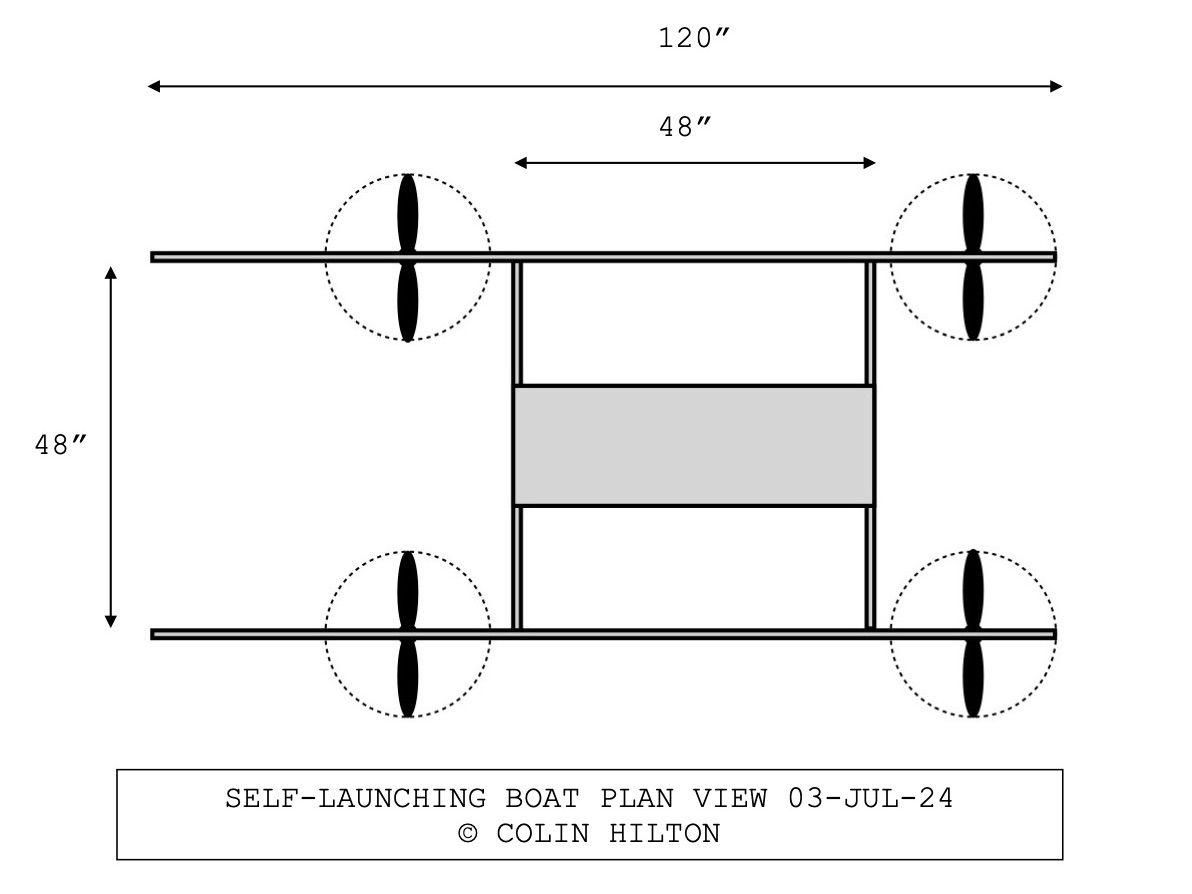
Notwithstanding my suggestion that we test the craft in the hover first, it is actually a better idea to test it initially as an airboat. This is because (a) any quad can be made to hover and (b) tuning it is expensive, not least because it requires four motors in lieu of two besides a flight-controller.

What you see above therefore is two alternative positions for fitting a motor to each  pontoon, and not a recommendation for a pair of propellers... although it might be.

In order to test whether the boat performs better with a mid-mounted pusher or high-mounted tractor, we shall replace the swinging arm with a fixed king-post as seen in the diagram.

It shortens the overall length of the craft to nine feet, for it's the motion of the swing-arm to the horizontal that extends it to ten.

It's a revolutionary boat, but assembled with good old-fashioned joinery skills... good to know then that I was useless at woodwork at school.

But can we build it? Yes Bob, we can.

Wednesday, July 3, 2024

Oh, We Do the Okoume... Oh, We Do the Okoume!


I've been browsing the web in order to choose a sheet laminate for the sides and deck of our flying boat. An obvious choice is carbon-fibre, seen as sexy by most designers, but only so you can wave it like a Rolex to show how rich and clever you are.

Sheet alloy is comparatively cheap, but the first site I looked at in Nottingham wanted £50 for the material and over £400 for delivery. WTF, I asked them... you sending it on a summer holiday?

Am drawn however to this nice man's hardwood ply up in the Lake District, which is as inexpensive an option as any, beside drawing upon a rich tradition of boat-building. As a consequence I plan to take the trailer up there and join him in a tot of rum and a few "Ahaaars."

Somewhere though a monkey has woken up and is wondering where it's tree has gone.

RIB-tickling Inventions


Possibly the most influential innovation ever on water, the inflatable boat dates back almost two hundred years (and that coming from the UK unless you count hanging on to the bloated corpse of a seal). What made it the most populous form of watercraft ever, however, was the addition of a plywood floor by a headmaster in Wales with the assistance of his sea cadets.

For you just never know whether something will succeed, unless it's one of mine and then you know it won't.

This is a picture of the very first rigid-bottomed inflatable, recently restored.

4-4-2


The principal obstacle to building the SLB is currently the fact that I'm tired of life and leap out of bed each day thinking, Fuck... is this all there is? To the extent I've drafted a promo vid in which I walk on stage in a black Miyake polo-neck and say, "Hi! I'm the CEO of TELEDRONE and I'm here to tell you how tired of life I am. Can't you just give me the money anyway, and save me building the boat?"

Nonetheless it's therapeutic ~ like a jig-saw for idiots ~ principally because it doesn't involve seeing other people. 

So this is how I'll outline the catamaran, based on a construction using a single sheet of plywood.

Three outlines arise from this draft as to how the prototype should be tested viz. (a) in the hover (b) moving on water and (c) transitioning from one state to the other.

Though the most sensible would be to test it on water, the more expensive option of getting it to hover first may make for better PR, because nobody on Earth has seen a boat carry itself from the driveway into the water.

4-4-2 incidentally is the classical formation for the outfield players in a soccer match. As it refers to previous designs, however, I've always found that the ideal ratio of width to length is between one to two-and-a-half, and one to three. Thus the outline above has hulls ten feet long, divided between forward, midships and stern at 4', 4' and 2'.

It may turn out to that it is in fact able to skim across (albeit calm) water even in the absence of those rear propellers being vectored for forward thrust.