Thursday, February 3, 2022

Room (for) 101


Added to the hundred existing artefacts in the world's largest collection of helicopters is the fifth of our prototypes, as flown back in the first week of December of last year. And here in the foyer the proprietor himself in front of the oldest surviving helicopter in the world in the shape of Hefner's Revoplane. The cost of this was underwritten by a British cotton millionaire, doubtless derived from the industry in Lancashire... that great seed-bed of aeronautical development in the UK!


and blurb:

Among the many hundreds of experimental ventures worldwide in the field of ‘personal air vehicles’ or PAVs, the TELEDRONE was designed and built by Colin Hilton as a spin-off from his earlier entry into the Boeing-sponsored ‘GoFly’ challenge, which took place at NASA Ames in Silicon Valley early in 2020. 

The development of air vehicles of this kind was made possible by the digital control of increasingly powerful motors, alongside improvements in batteries and electronic components derived in large part from the mobile phone industry. Effectively a scaled-up quadcopter, the operation of this scale prototype by radio-control was possible by registering it as a regular drone ~ an avenue open in both the UK and US up to a weight-limit of 25 kilograms or 55 pounds.

Further development is possible in the UK at weights of up to 150 kilograms by special permission from the CAA, and thereafter at greater weights again under Experimental Category. Thereafter however regular certification would be required, which is a process evolved over decades and aimed at piston and turbine types and as such, prohibitively expensive. It is not the case in the US however, where in an effort to stimulate the development of ‘eVTOL’ types the FAA allows for such aircraft as this to be flown largely without regulation up to a gross weight of over 115 kilograms so long as there is a pilot onboard. Consequently TELEDRONE types like the one seen here will be scaled up to adult size in order to be pitched to the US market in the form of rapid kit-builds.

Technically the airframe comprises a patented four-pronged cantilevered structure to support the centre-body, whose advantage is that it is effectively a two-dimensional construct adaptable to conventional fabrication in aluminium. In the case of this latest version of the machine, however, this is bounded by a 48” square perimeter frame that extends to four undercarriage legs in support of either skids, floats or casting wheels.

In order to pack the remaining components as practically as possible, the avionics are situated on the underside of the central section, and comprise a radio receiver linked to the V-aerial at one corner of the airframe, beside a Pixhawk ‘cube’ flight-controller (to which GPS signals are fed from a disc-shaped antenna located at another corner). The controller is wired in turn to each of four ESCs or ‘electronic speed controllers’ which control the four 6 kilowatt motors digitally as ‘virtual’ AC motors albeit running off a DC supply. The supply itself is drawn from a pair of 22000 mAh battery packs wired in series to produce around 45 volts.

The prototype thus has an endurance of between ten and fifteen minutes, with each motor requiring only a fraction of the potential 100 kilograms of installed thrust required to support the gross weight of 25 kilograms. The test-flight was undertaken on the 2nd of December in 2021 at Frome model aero club on the Somerset Levels, with the wiring, tuning and test-flying pursued by Angus Benson-Blair. The subsequent development phase would see the airframe expanded to 60” square and powered by 10 kilowatt motors driving 40” propellers in pursuit of elevating a mannekin by radio-control and thereafter an adult pilot onboard using hard-wired controls.


Max Speed 63 m.p.h. (FAA Part 103 Ultralight limit) in ground-effect

Empty Weight         20 kilograms

Capacity         1 child

Power 4 x T-motor 5.5 kilowatt motors (equivalent to 22 HP)

Tuesday, February 1, 2022

Twilight of the Quads


As we move toward full-scale, it has come time to retire the sub-scale: age shall not weary it, nor the years condemn...

Sunday, January 30, 2022

Radi(c)al Thinking


The early helicopter and radial piston engine were a meeting of minds. Unlike airplanes of the time, which required a crank-shaft lying prone driving a propeller, helicopters would need a drive-shaft in the perpendicular and the pancake outline of the radial engine was ideal for laying flat on the floor as can be seen here on the left in one of the earliest helicopters in the shape of the Bristol Sycamore; in fact it could be argued that the radial engine was a better fit in helicopters than in fixed-wing aircraft.

Nonetheless pitched around the centre of gravity it clearly occupied much of the space that might be given over instead to payload, and as a solution to this problem in another early helicopter in the form of the Wessex Whirlwind it occupied the nose instead, from where its drive-shaft passed between the two crew: with the benefit it took up less space altogether. And though it would add a deal of weight forward, this would be compensated by the rearward extension of that area given over to payload in the form of additional crew or passengers.

Looking at each installation however ~ and notwithstanding the gear-box at the top end beside a complex rotor-head and tail-rotor assembly ~ one can see how simple an electrical multi-copter is instead. Given an analogy I would say it is like comparing the movement of a conventional watch with the quartz oscillator and battery that more or less replaced it, except among those who wear unnecessarily complex watches by way of an investment or fashion statement.

Perhaps this is the fate of the conventional helicopter?

Saturday, January 29, 2022

Ring a Bell?


Used as a child to watch these things crop-spraying and making death-defying turns at either end of the field at tree-top height... Bell's inimitable 47. The plexiglass bubble that became its 'signature' was an early addition, at suggestion of someone familiar with the relatively recent introduction of plexiglas.

South Yorkshire Aircraft museum.

Tuesday, January 25, 2022

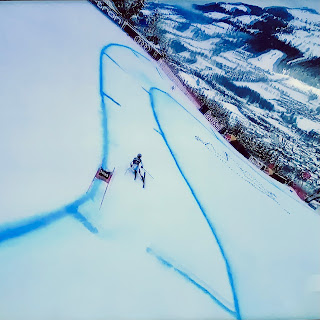
Kit's Buhel


What is most remarkable about this footage is that unless otherwise enlightened we nowadays take it for granted, as with every other aerial shot featured in films or on TV.

From the outset aerial video was seen as a 'killer app' for drones that might otherwise serve few purposes beyond entertaining RC modellers traditionally viewed as geeky ~ whereas nowadays dramas and documentaries are regarded as incomplete without a sequence shot from above interwoven with those from ground-level.

And in the way that this has snuck upon us largely unnoticed over the past ten years or so, drones large enough to carry people are likely to reiterate the same evolutionary path.

Or will do if I have my way.

Tuesday, January 18, 2022

VFS

For some people it stands for Visa Facilitation Service but for cognoscenti it's for the Vertical Flight Society and their database of practically six hundred separate projects around the world connected to electrical means of vertical flight. Between us we've called this latest outline the Mark V if only because I don't see another any time soon, what with it having ticked all my boxes the hard way.

It is actually listed as the Mark V (scale) as I don't want a proliferation of marques that would only confuse the public, if they not already confused enough by a dazzling array of projects worldwide. Once scaled up to adult proportions it will therefore be called the Mark V (beta) and thereafter and in fully-fledged form, simply the Mark V.

On one hand it's a naming convention I wish I'd thought of sooner, but on the other the V and IV marques of Spitfire were supposedly the best... so who's complaining?

https://evtol.news/teledrone-mark-v-scale

Monday, January 3, 2022

Gone Fishin'

As part of a crowdfunding campaign in 2022 set to enlarge the prototype to include an adult, the blog continues at medium.com where development to date is recounted, commencing here:

https://medium.com/@colinhilton