Sunday, October 22, 2023

Fan Club


The best hope of developing eVTOL lies in diversifying its core technologies, not least because it has derived any number of them from developments elsewhere. Whisper Aero is thus reaching out for partners wishing to manufacture leaf-blowers instead.

While it may smack of Clive Sinclair's C5 being powered by washing-machine motors, it is not as bizarre as you may think. Leaf-blowers are banned in a number of areas in the US for being too noisy, whereas Whisper's is not. And the first garden vacuum in the UK was built by an aerospace engineer: he didn't want anything else being sucked up beside leaves, and turned to the Magnus effect employed in NOTAR helicopters to eliminate the tail-rotor.

I shan't be recommending fans for the the 'DRONE, however, for as yet they cost upto ten times more than a motor and propeller producing the same amount of thrust.

The pic shows Whisper's own demonstrator... designed and built in just eight months.

Friday, October 20, 2023

Ptero-tactical


Occasionally browse eVTOL videos and this one stands out for garnering rather more views altogether than most others, in view of the fact that it folds its wings during the transition to a hover. What is remarkable about what PteroDynamics has done is that it is among the few configurations that reflects what nature does best whether among birds and insects.

It is worth considering, for why do species evolve towards folding wings whilst aircraft ~ with the exception of a number of carrier-borne types in the past ~ do not? Almost certainly it has to do with the practicalities of manoeuvring on the ground, where (in view of the energy input required to fly) most such species spend much of their time.

To date folding wings have been structurally difficult to arrange and have added a deal of weight to the finished object, but with computer-aided design and the flexibility of installing multiple electric motors this is set to change. Undoubtedly, therefore, what attracts defence budgets to this notion is the facts the footprint lends itself to ready storage and deployment in the field...

... a notion fuelling my own obsession with producing the lightest possible foot-print.

The final assembly and test-flying of the sub-scale TELEDRONE is meanwhile delayed until the start of next month, due engineer-come-test-pilot moving to new premises. Console yourselves with the fact that nothing worthwhile was ever achieved in a hurry.

Sunday, October 15, 2023

Air-Go-Nomics


The 'Spinner' is described on the website as revolutionary, and is so only to the extent that its propellers go round. It is though obligatory nowadays for every eVTOL designer to say as much nowadays, whereas a generation ago you'd design a Comet or Boeing 747 and be lucky if anyone else said so.

You could argue that the German brothers who rigged a bathtub to fly were in fact the first to settle on the layout, and prior Jetson too. It does though show how the effort to accommodate seated passengers is a greater ergonomic challenge than standing them in a flying phone-booth. The 'one-size fits all' model is used in every automobile and airliner, but usually accompanied by adjustable seat, steering column and pedals.

The quandary is illustrated by Opener's Part 103 offering, seen here below. More work than attends any other has been afforded Opener's various prototypes, but I may not be alone in feeling this one looks like something that needs eradicating with a medical shampoo?

Wednesday, October 11, 2023

Moy... Er?


This cargo-carrying drone from Moya in Latin America is not nearly as pioneering as its LA backers LA (Techstars) suggest, being a straight rip-off of Blackfly's Opener albeit adapted for cargo in lieu of a passenger. With the latter set for real-world customers in 2024 and the above with a deal of aviation experience behind it, it looks to succeed as a configuration. Bear in mind though that the cargo version has four rotors in place of eight, bearing as it does a payload of less consequence altogether.

There are four enduring forms of helicopter, viz. main- and dual- rotored, intermeshing  and co-axial in order of numbers commercially produced over many decades.

With eVTOLs the same evolution is likely to take place, though it may yet feature more 'phenotypes' or variations. The simplicity and practicality of this 12-year-old concept is likely to ensure that it is one of them.

As we await the flight-test scheduled for the TELEDRONE sub-scale this month, the notion that if nothing else its layout may stand the test of time is a source of comfort, but not much of one.

Friday, September 29, 2023

Hover Bother


We owe a debt to those YouTubers who painstakingly stitch together footage like this Ultimate Helicopter Crash Compilation:


Given the fairly recent availability of inexpensive means of video capture as compared to the length of time the helicopter has been with us, it also represents the tip of the iceberg. The reason that flight statistics are so benign when compared say to driving the car is because they are vastly skewed by the safety of flying in a highly regulated environment in which say airliners operate, or indeed commercial helicopters. It is as if the safety of using an automobile were represented by, say, the number of fatalities suffered by passengers using a train or a bus.

Rather than the crash-bang-wallop ethos attaching any number of videos, its author does hazard too the generic cause behind each set of accidents or incidents. This is worth consideration, because much of this 'real world' operational experience will be carried over to the use of eVTOLs in future.

And the fact is, watching this it is hard not to think that in many scenarios eVTOLs will actually be relatively safer than a helicopter, and especially for the up close and personal spheres of operation at which rotorcraft have long excelled.

These are the tail-end of the operating environment in which the bulk of helicopter missions are flown, as elaborated above in relation to the apparent safety of vertical take-off types as drawn from the statistics. Nonetheless safety in the modern world is a double-edged sword that operates within disconnected spheres. We work in overly regulated environments and drive around in cars that are paragons of safety, whilst at the same time being much more likely to be knifed to death or killed by a drug-fuelled joy-riders than ever.

It is worth considering how eVTOLs will evolve, therefore, because they will do so like all technology in ways we could not envisage and beyond control of society in general and the law in particular, as is the case with AI or indeed the disintegration of society fuelled by seemingly harmless platforms like YouTube or TikTok.

For the centre will not hold, and the technology is likely to devolve between relatively safe and stupendously capital-expensive means of replacing helicopters in moving the affluent between down-town locations... and the rest of us. That rest of us is likely to use comparatively inexpensive electrical means of taking to the air much like those in these videos did, only moreso. The accidents involving eVTOLs will therefore provide a richer source altogether of footage that, should you wish to, you could watch all night.

Could we sleep afterward, though, having helped bring such things to fruition? I think we could, for the reason whatever we don't develop then someone else surely will. It is thus incumbent upon pioneers in the field ~ and I don't count myself among them ~ to make personal air vehicles as reasonably safe as we could expect them to be at the outset.

Wednesday, September 27, 2023

Post (-ponement)


These props - literal props ~ are growing cobwebs, whilst the tuna in the cans is most certainly off. Flight testing of the scale prototype is postponed until the second half of October whilst our engineer is re-allocated to work of a more military persuasion. In the UK when developing eVTOL concepts you're up against behemoths in the form of the grant-funded military-industrial complex on one hand and Hollywood's perennial need for aerial footage on the other. We in contrast are the rednecks in the back yard.

Thursday, September 14, 2023

Pendulous Thoughts

Up there with questions like 'How does a wing produce lift?' an endless debate is the issue of whether or not pendulous stability actually exists in flight, at least beyond hanging from a balloon in a basket is concerned. Tom Stanton's excellent video would suggest that it's a mythical beast, whilst aircraft that are supposed to be extra stable in view of an overhead wing or rotor appear to be anything but to pilots.

The controversy is complicated by the interaction of forces attributable to drag and an interplay of all forces in a realm of aerodynamics. In an effort to grasp the essentials however I prefer to defer to real-world experience, and people who know a great deal about drones tell me that flying with a suspended load ~ whether tethered or fixed ~ is increasingly challenging when that load becomes further removed.

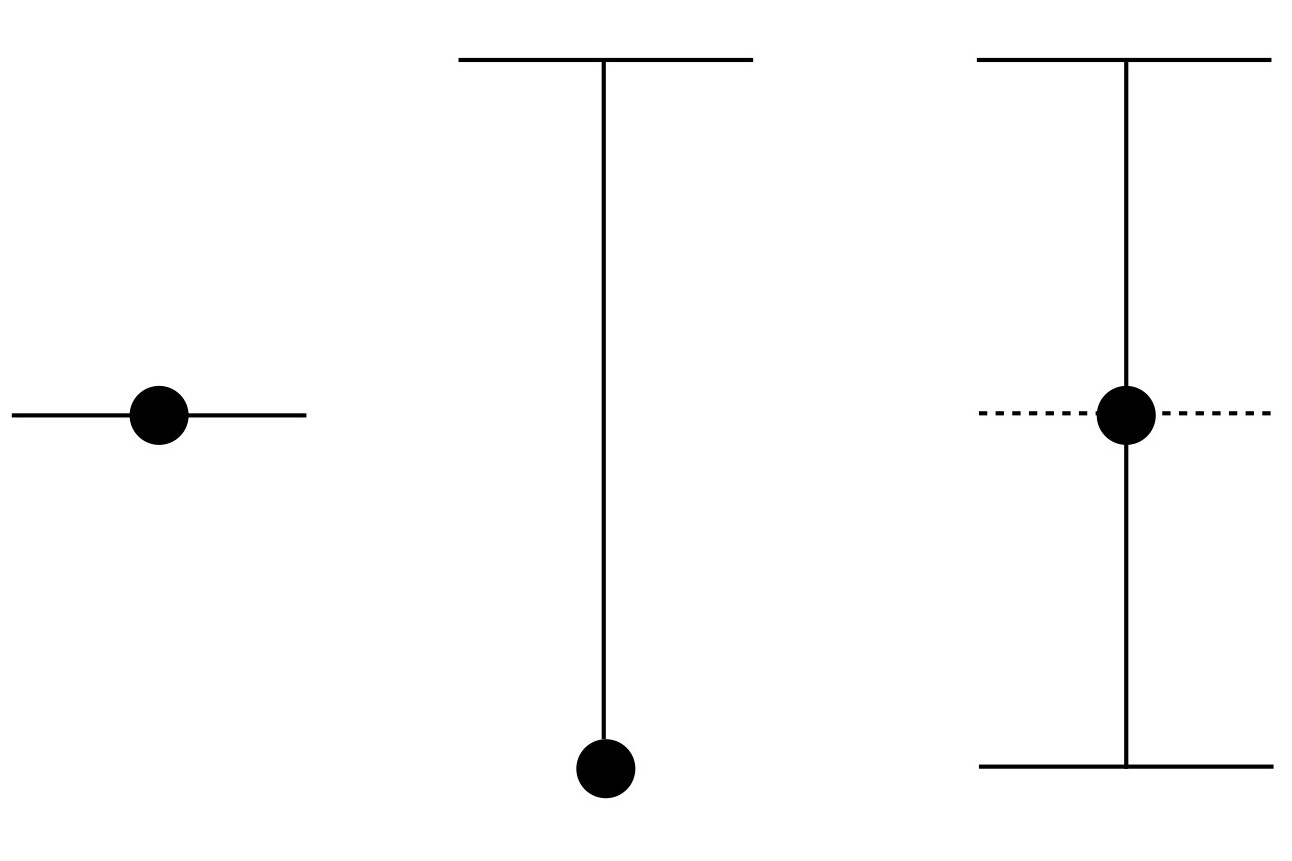
The issue is inherently inertial and could be considered in the absence of flight, as on the ground or suspended in space. The first diagram shows how all successful drone manufacturers start out in designing an airframe, not least because it is the easiest to produce in moulded plastic. Forces applied near the end of either cantilever have only to rotate the central mass to vector thrust, so there is clearly not a good deal of extra energy required. An example is moving boxes around a warehouse floor, best done by shouldering the load in line with its centre of gravity.

Further removing the centre of gravity, as in the second diagram, complicates matters considerably and matters not whether a drone is arranged with mass far above or far below. Take for instance balancing a pencil on a finger or telegraph pole in both arms. Whilst vertical, the force due gravity passes through the support, but falling produces a vector that also acts in the direction of lean.

Now that can be compensated for in the event whoever balances pencil or pole runs sufficiently fast as to counterbalance the additional vector. Clearly though a good deal of energy is required, and this is as true for the drone as for you or I. What it means in turn is the drone loses its ability to manoeuvre, because it requires a certain level of thrust to stay airborne, and a large margin of extra thrust in order to change direction.

Looking at the disposition of load and thrust in the second diagram it is clear that the drone has less purchase in altering the position of the mass; furthermore it is inclined to rotate around that mass like Earth orbiting the Sun. The only way of preventing this is again to add thrust and we don't know from Tom Stanton's experiment how much, because he doesn't measure it... take YouTube videos with a pinch of salt.

All of this suggests overhead or underslung rotors reduce baseline manoeuvrability, in one case because a larger moment arm is necessary (evidenced by the diameter of a helicopter main-rotor) or in the other because excess thrust is always going to be needed to correct departures from level flight. This suggests that helicopter look-alike such as Volocopter or Hexa will not set the world alight compared to air vehicles like Jetson or Airspeeder, which centre their mass.

The third diagram is why I concluded that if the TELEDRONE is to have eight rotors for redundancy (and to keep it compact), they are ideally distributed vertically as well as horizontally. All else being equal, thrust applied to the cantilevers seen in the diagram should act around a mid-point. This is about where the vehicle (and our own) centre of gravity is located, thus restoring the available purchase we see in the first diagram.

Whether this works in reality is something that we hope to see prior month's end.