Tuesday, March 12, 2019

Static Load (Off My Mind)


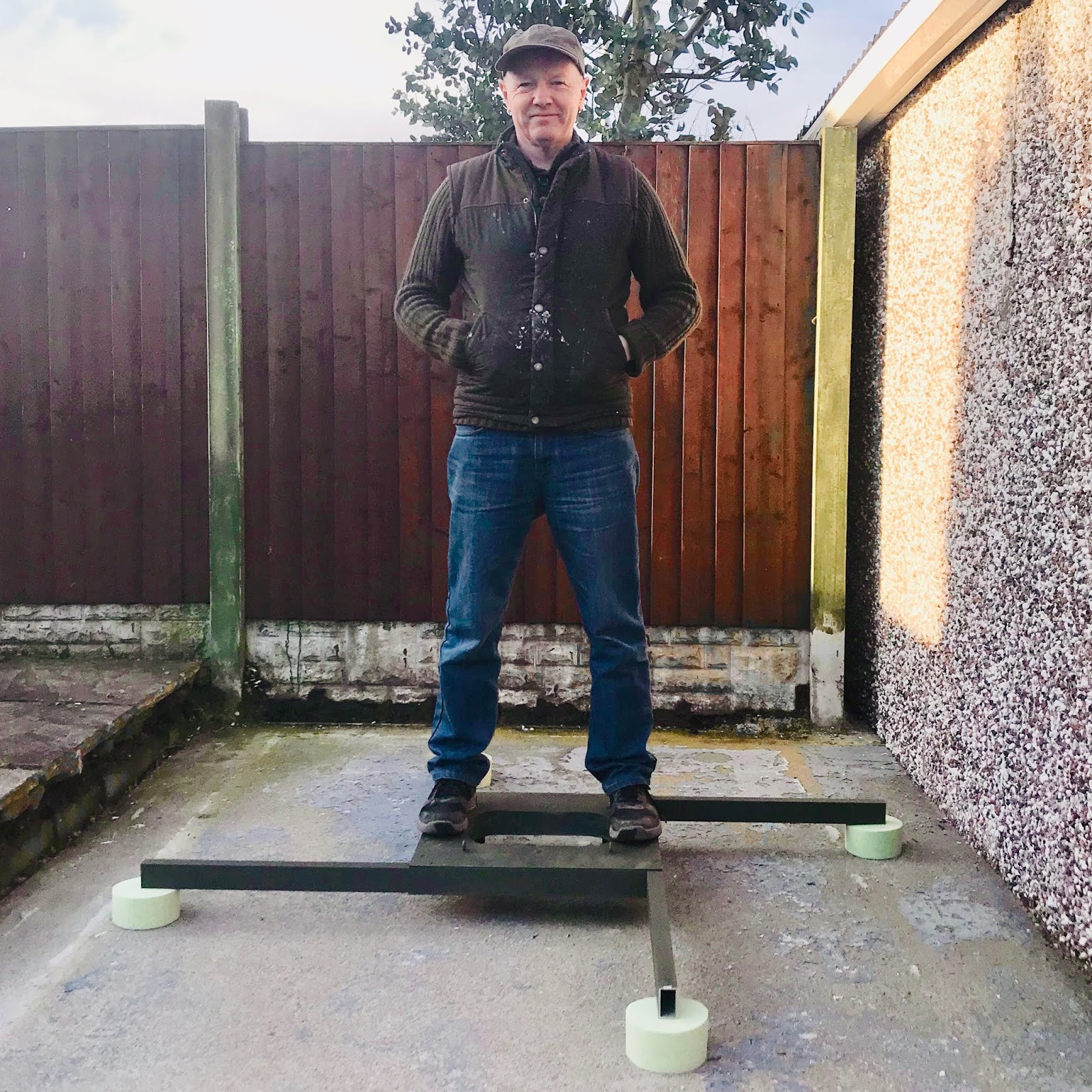
After a touch-up in NATO green ~ sorry about that, Vlad ~ the prototype is put through a Teledrone 'A' check to establish whether its airframe is able to support my own 75kg frame. Creaks and gives a little as it should, rewarding my punt on 3mm spars for the rotor-arms.

But no ex-works shakedown is complete without a 'B' check, involving a full suite of wheelie-bins in lieu of anything more practical. For the engineers amongst you, green is for garden waste; blue for tins and bottles; green for paper and grey for general waste.

With commander Neil Armstrong settled into the flight-compartment (albeit stripped of his pullover due constriction) we're go for Tranquility.

We move next to the 'C' check, swinging me inside the lunar-lander from the rafters... a procedure every astronaut will surely have undergone to acclimatise to weightlessness.

And all before tea.


'Pro' Pellers

There's a dearth of propellers out there for personal air vehicles (PAVs)... but before I begin, a word on the TELEDRONE philosophy. I call similar ventures in the UK and they are either extremely cagey or else don't respond at all.

I'd like to think this is because they consider me crazy, but sadly I suspect that they feel they are giving away precious trade secrets.

They're not. They're just slowing down universal adoption of world-changing technology by navel-gazing and mistrust. And neither of those get results.

Therefore yes, I file intellectual property but no, what I do is neither state-secret nor rocket-science and therefore I shall be sharing as much as I possibly can with you. Not least kits to build your own flying machine, and sooner rather than later.

There is not too much out there on WHY there are no blades for large drones, but as good an explanation of why lies here:


Stick with it as it gets more understandable, though easier still is to read my summary here because I'm the dummy who put the dummy into aerodynamics for dummies.

Firstly then, as I always wondered why the blades look more like airscrews and less like rotor blades off helicopters, it turns out that much of it has to do with the fact that drones are steered by rapid changes in rotor RPM while for helicopters this is anathema.

Secondly the best-known firm addressing this market is T-Motor in China, whose products I shall likely be using sooner rather than later.

Thirdly, rotors are broadly three times less efficient than fixed wings of the same profile that generate lift from forward flight, and...

Fourthly, this efficiency can be recovered somewhat by larger rotors, for which the TELEDRONE was designed from the outset ~ we surf with the flow of aerodynamics.

Accordingly I shall likely plump for their (largest or) 10 kilowatt motor driving their (largest or) 40-inch propeller.

It's on a par with the Turnigy 150, but I like where the founder of T-Motor came from, and where he's headed.

And investors look at that sort of thing.
Monday, March 11, 2019

Weight Watchers


Depressed Sunday evening and go to bed at seven and stay there for the next thirteen hours.

Can't remember which engineer built the first canal in the UK (for the Duke of Bridgewater as I recall), but I do recall he went to bed for three days to mull it over before kicking off the industrial revolution.

I'm probably borderline polar, but then most inventors are.

Four more pins around the periphery of the port-hole, two licks of paint and four feet made of rubber door-stops and we're good to go.

The dry weight of the airframe, less engines, is a fraction under 19 pounds or 9 kilograms.

Not at all bad for a prototype helicopter at this stage of the game, and I figure I could halve that using more exotic materials and refined production methods, but it'll do for starters.

The target motors weigh 2.5 kilos (5.5 pounds) apiece and we could yet go for the smaller and lighter version, but I want an excess of power available to that left hand as we'll be up against the personal jet-jockeys.

At twenty kilos without batteries we're two-thirds the weight of a paramotor, excluding the canopy without which it cannot fly.

Whilst we're at it the basic span (measured at a 15mm inset across opposite rotor-arms) is 1.60 metres, which allows a full metre or thirty-nine inches for each propeller.

Debate whether to use two-bladed propellers for ease of use ~ else three for more thrust and less noise ~ but prefer the former for its sheer practicality.

Next up in the activity stakes are the static load tests, for which I have to book a slot at our very own static load testing facility.

This consists of the engineer's barn, and his block-and-tackle.

Onward and upward... literally.

Sunday, March 10, 2019

Who's Drab Olive?

I settle on drab olive, not least because I discover Halfords sell the spray-paint canisters.

Plus flying over minefields wearing a 'hover-pack' is likely to appeal to military types... noting that the original interest in (and use of) aeroplanes was for military observation.

Beside this, people like Red Bull appear to be going out of their way to sponsor folks like me who want to be elevated by personal air vehicles (PAVs), and to date these feature jet-packs like this one developed in the UK:


Or else this one from Australia:


Both of these guys seem to have chosen to wear black, either to match their equipment or else to look like an action-hero, so I'll go green instead.

Incidentally, they can each sell you one of their 'PAVs' for around a third of a million dollars, a figure I hope to under-cut by a factor of around 100.

Leyland-y


Saturday afternoon I took a break with my son and drove to the transport museum in nearby St Helens.

In Lancashire you are surrounded by the ghosts of the industrial technology and its subsequent technical progress, not least in aviation. St Helens itself was where float glass was invented, the means by which every window you see around you nowadays was made.

This bus is from up the road in Leyland, a place latterly famous for the production of commercial vehicles and whose museum still includes Rudolf Diesel's prototype engine.

Like phone-boxes, UK buses are legendary, and this prototype is the evolutionary equivalent of the 'missing link' betwixt ape and man.

It has the open rear-end which I used to leap on and off at speed enroute to school, but instead of the forward-mounted engine and drive-shaft, its power unit has been relocated to the rear.

This optimised the use of space, shifted the weight to the rear axle where it was most needed and made access for maintenance altogether simpler.

As a result, engines in buses have largely stayed there ever since.

We do stuff, hereabouts.

Saturday, March 9, 2019

Your-e-car!


A red-letter day as the airframe is completed on schedule.

The four eye-bolts pin the frames together like a port-hole, and double as attachments for the webbing or shoulder-straps that operator uses to support it on the ground.

For more bolts will be arranged around the aperture, but likely do not need to be fastened to my human frame as I believe (hope) that I can get away with a four-point harness.

Then it's off to the paint shop, with the prototype set to be drab olive, silver or matt black.

I should probably have used anodised alloy rotor-arms to save on paint, but then it's always good to save something for later.

Friday, March 8, 2019

Hot off the press...


I don't have an autoclave like Airbus, but this is the next best thing.

With the spar-uppers lavishly smeared with metal epoxy and the foam-infill liberally coated with polyester resin, on goes the top-plate and then I bang in the forty rivets that secure it.

Then it's overlain by a metal drip-tray ~ actually one of those metal posters that read 'Man Cave' along with the applicable rules ~ and action-man weights. I then pour three kettle's-worth of boiling water over it, so that it looks momentarily like a chocolate fountain.

The whole is then snugged up under a dust-sheet, and left to stew in its own juices while I go for tea and cake.

I don't do this for my own entertainment (well, actually I do) but because I worked with a fibreglass fabricator once and learned how to accelerate resins.... and with less than two hours 'til 05:00 pm Friday we're anxious for the roll-out to stay on schedule.

It's already involved me missing a yoga lesson this week, but as Otto Lilienthal said after his fatal accident, sacrifices have to be made.